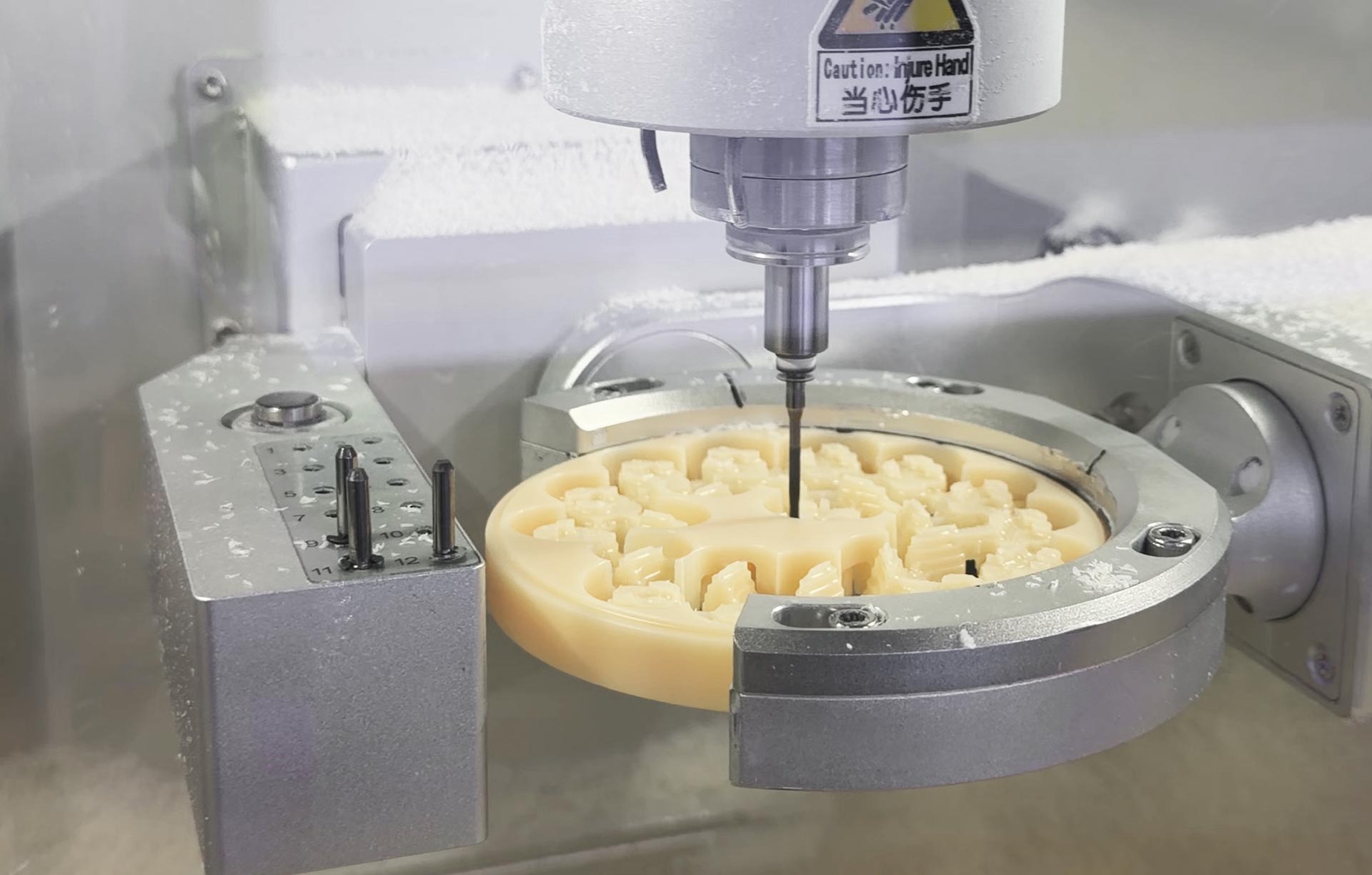
digital workflow stage
Dental Milling Machine
The Dental Milling Machine is the equipment responsible for transforming digital files into physical pieces, such as crowns, prosthetics, and implant structures. It is the production core of the CAD/CAM workflow, enabling precision, standardization, and scalability in digital dentistry.
There are different types of Dental Milling Machines, varying in number of axes, power, milling type, and production capacity. Understanding these differences is essential to choose the right equipment for clinics or laboratories and avoid future limitations.
Discover 4 key features to analyze when buying a Dental Milling Machine

Number of axes and piece complexity
4-axis milling machines work well for crowns and simple restorations, while 5-axis machines enable production of complex structures, such as extensive bridges and implant bars, without manual repositioning.
Milling type: dry, wet, or hybrid
Dry milling is ideal for zirconia and PMMA, while wet milling is essential for disilicate and glass-ceramics. Hybrid milling machines offer versatility but require more maintenance and operational management.
Spindle power and performance
Spindle power defines speed, cutting capacity, and productivity. More powerful equipment reduces milling time, increases efficiency, and enables working with more demanding materials, including metals at more advanced levels.

Structure and production capacity
The machine’s weight and robustness directly impact stability and precision. More robust equipment is recommended for continuous production, while compact milling machines better serve clinics and smaller operations.
Check out the Dental Milling Machines below
Discover the leading dental milling machines for clinics and laboratories, with brands such as Amann Girrbach, VHF, Roland DG, Ivoclar, and UP3D. Check out the available options below and identify which solution makes the most sense for your digital workflow.
Nenhum produto encontrado.
Discover some advantages of buying a CAD/CAM Dental Milling Machine
In-house production and greater process control
- Reduces dependence on third-party laboratories
- Increases predictability and standardization
- Enables total quality control
Productivity and scalability gains
- Continuous and automated production
- Reduced time per piece
- Ability to increase volume without expanding team
Portfolio expansion and financial return
- Expands treatment offerings (zirconia, PMMA, disilicate)
- Enables handling more complex cases
- Generates new revenue sources with digital workflow


